In the early 20th century, American movie studios often maintained in-house art departments and backdrop facilities, a system that flourished until the 1960s when studios increasingly began outsourcing backdrop production to independent scenic companies.
According to Phil Greenstreet, Head of Rosco Digital Imaging (RDI) Technical Development, as the studio system changed, vendors such as Rosco became “the repository of knowledge” for backdrops.
Founded in 1910, Rosco is one of the longest-established companies in the entertainment industry. Best known for its color filters, gobos, fog products and scenic paints, the company has especially played a role in the evolution of backdrop technology.
“To maintain that kind of lifespan, you have to evolve continuously,” said Greenstreet, who joined Rosco in 1992, when the company began developing computer-printed vinyl backdrops.
At Rosco, Greenstreet helped introduce Day/Night backdrops, which received an Academy Technical Achievement Award in 2001 and an Engineering Emmy Award in 2004.
“To be absolutely honest, it was a shameless rip-off of a 17th century theatrical technique: backpainting,” Greenstreet said. “People were saying, ‘Well, you can't get a computer to align these two images.’ It turned out that we could, so we did.”
In a video call, Greenstreet spoke with the PDC about photographing backdrops, the evolution of digital scenic printing and the technical process behind Day/Night SoftDrops. The following conversation has been edited for length and clarity.
PDC Coordinator Madison Kloeber: Can you help production designers understand how you capture imagery for backdrops?
Phil Greenstreet: You're trying to capture what's out there, but you want to be unobtrusive about it. Obviously, the actors are front and center, and the production design within a room is a featured character.
For backdrops, if you notice them, we've done something wrong. We're supposed to be invisible. We're selling the idea that you're somewhere else. If we've done our job right, you don't see us at all. Usually, it's more of a technical challenge because you're not trying to be an artist.
What we want to do is create a matrix of images that can be assembled into one very large image. We make extraordinarily large images. The biggest one I've done lengthwise was 700 feet, so well over 200 meters. We're talking about some pretty huge scenic elements at times.
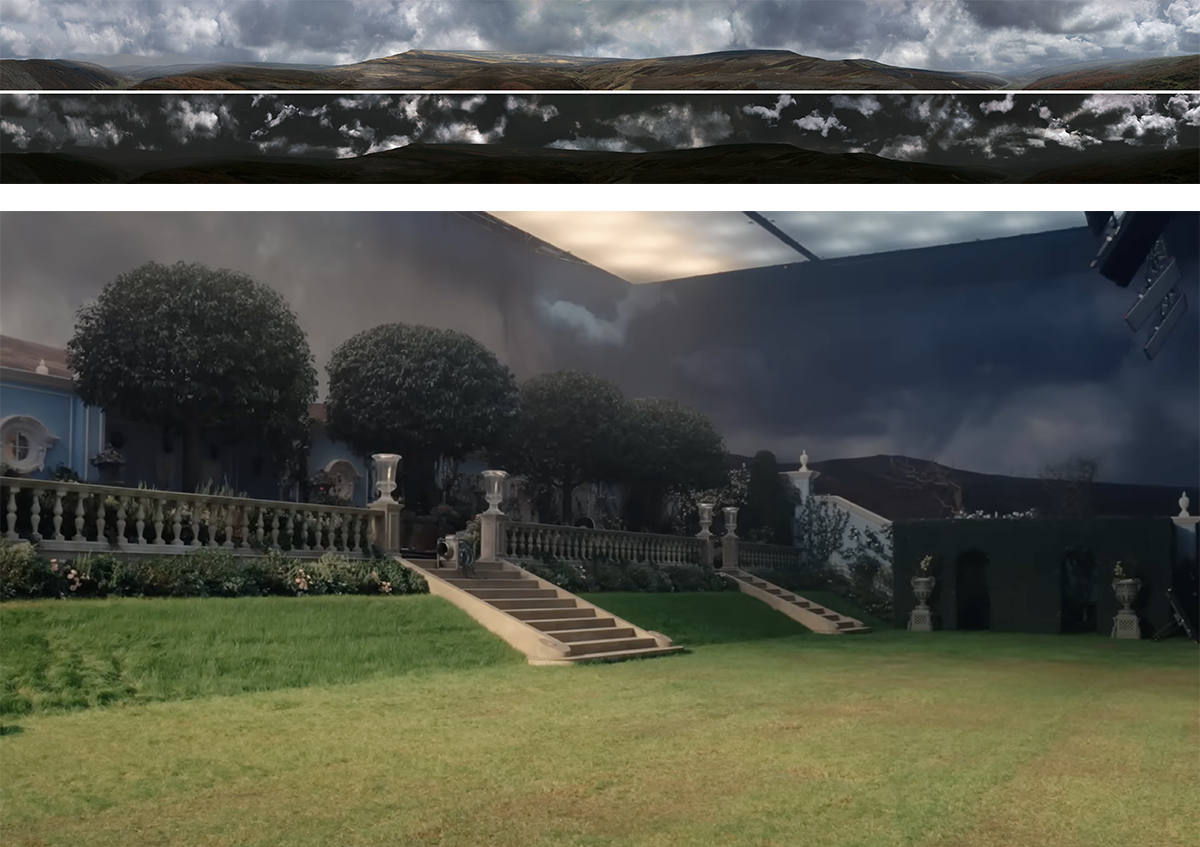
Final artwork (above), and the Rosco Day/Night SoftDrop—35 ft × 463 ft (11 m × 141 m)—installed inside the Thrushcross Grange set (below) for Wuthering Heights (2026). Production design by Suzie Davies. Image sourced from Rosco Spectrum blog.
PDC: What is your process of shooting while communicating with the art department?
Greenstreet: We work very closely with art directors because they're the people who employ us, essentially. We're almost an adjunct to the art department, but we're a dog with more than one master in the sense that we also have to answer to the cinematographers. Quite often, what they want is slightly at odds with reality.
Some cinematographers might want the backdrop image to be overexposed and blown out to start with, but you can't go anywhere else with that. Whereas if you start out with a good picture and over-light it, it's actually more realistic. There's a balance that we have to achieve between the art department, camera department and lighting department. In many respects, we act as the glue between those disparate elements.
Our first contact is almost always with the art director or production designer. They bring us onto the project, tell us what they want and give us an idea of size.
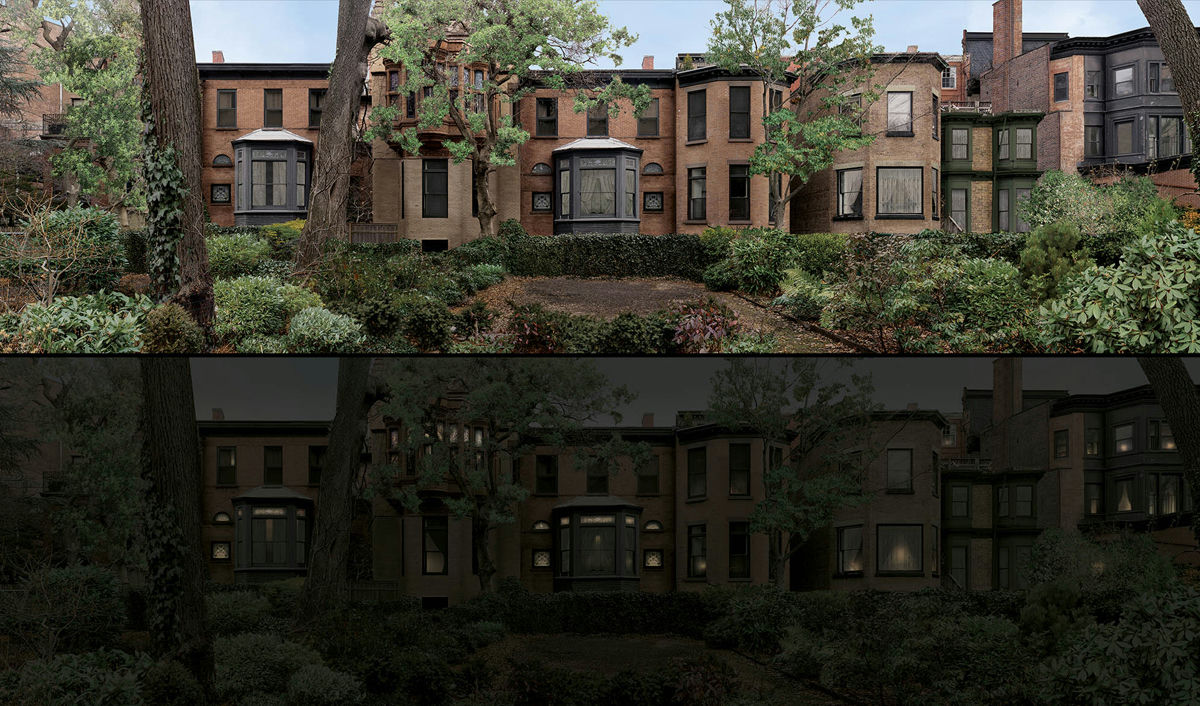
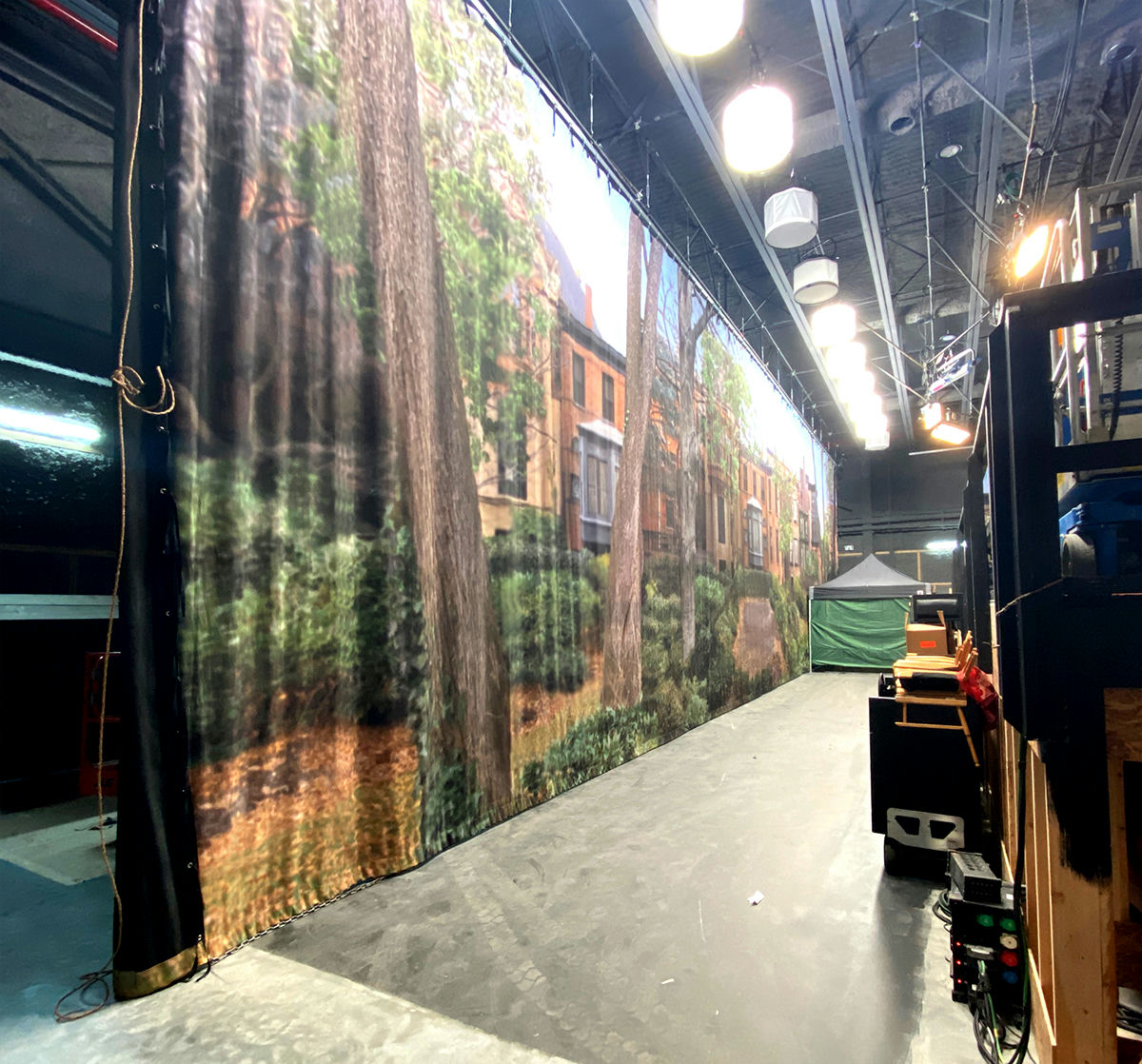
On The Gilded Age, which was designed by Bob Shaw, I went out with art director Laura Ballinger really early on. It was a period show, so there were many changes to be made. We also try to shoot more than we're asked for, which sometimes means thinking about the tree that's in the middle of the yard and taking extra photos to get what's behind it that you can't see from the house.
Trying to figure that out while we're also trying to figure out which elements we're going to be dropping in was complicated, but Laura had all the information. It was just a question of executing her plan.
Final artwork (above) and the Rosco Day/Night SoftDrop installation (below) for HBO’s The Gilded Age. Production design by Bob Shaw. Images courtesy of Rosco.
PDC: When it comes to getting the team more than what they ask for, what details do you pay the closest attention to?
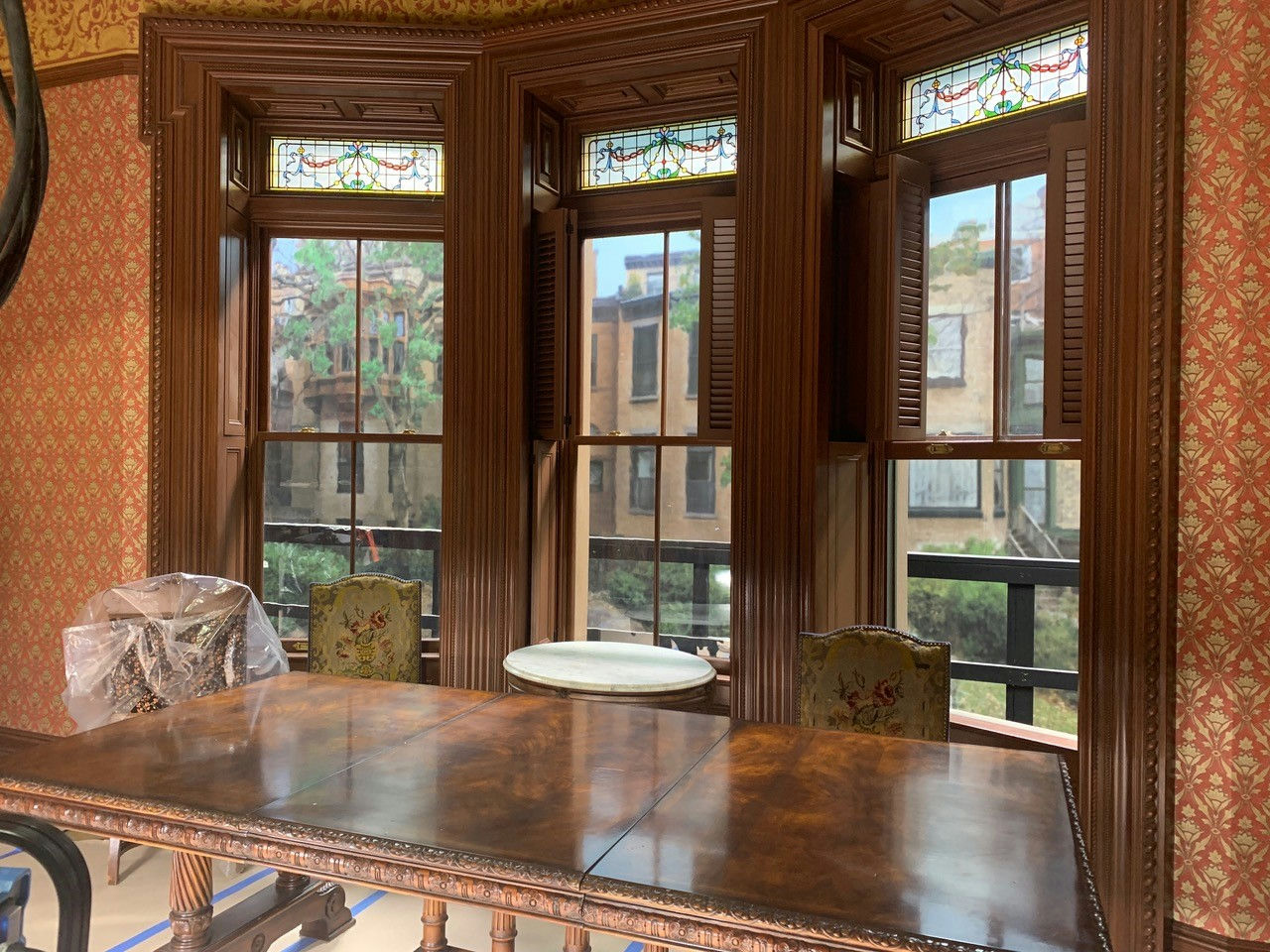
Greenstreet: The most important factor is generally scale. Typically, a backdrop is positioned 16 feet outside of a window on set. Sometimes 20. But what we're doing is mimicking something that, in reality, might be 100 feet away. The simplest way to think about it is to measure the distance on set from the window to the backdrop, and then to measure the distance on location from the window to the house opposite.
The other thing is horizon lines. You have to match the camera height. In reality, your eye level is what creates your personal horizon, but on set, it's the camera height that creates the horizon. If you get the horizon line wrong, you may not know why, but your brain will start screaming that there's something wrong with the background. It starts to feel like Inception where the buildings are kind of breaking over you.
Also, asking early on if it's a period piece is useful. This week, for example, our shoot will be for a period piece set between 1933 and 1943. What we did was go and find out what kind of lighting they had during those years in the New York area. It turns out that 1933 was when they started introducing low-pressure sodium lighting, so all of the street lights and background lights should have this very monochromatic yellow look.
A behind-the-scenes shot from The Gilded Age set with one of the backyard SoftDrops in the background. Image sourced from Rosco Spectrum blog.
PDC: This is a good segue into Day/Night technology, which received the Academy Award for Technical Achievement. What made it such an important innovation?
Greenstreet: Day/Night technology saves money because, instead of having two backdrops that you need to move around and take time to change, you just have one drop. With Day/Night, you make a lighting change and can start shooting again.
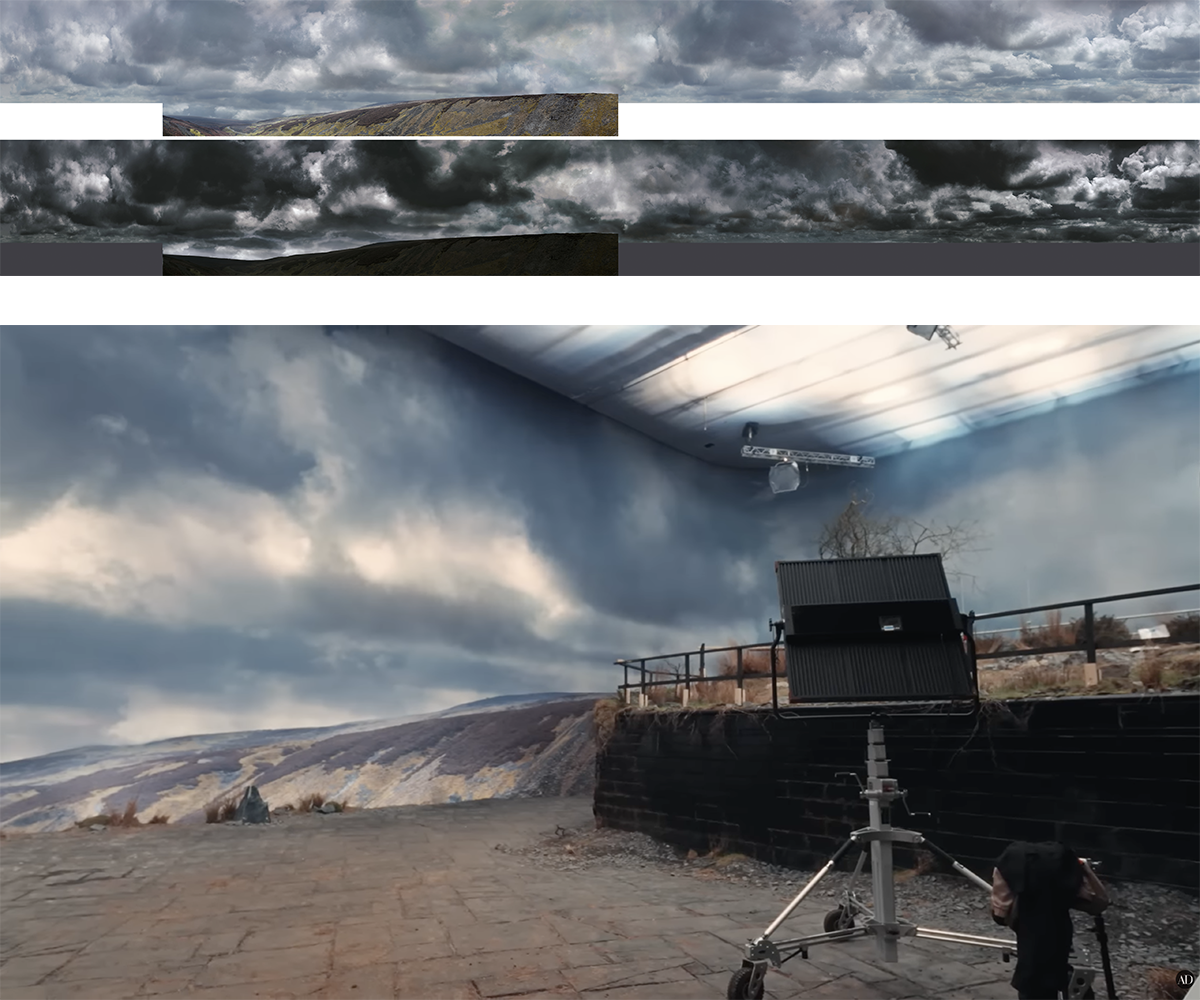
They're not just Day/Night, either. You can slowly transition from front-lit to back-lit and get a twilight look as well. It's cheaper, faster and there is more of a range of looks that you can achieve. If you think about Wuthering Heights as an example, there were very big drops with different weather conditions at different ends of the set. One end was stormier and the other was less stormy. By choosing the angles of the shots, you could actually change the weather, for both day and night scenes.
PDC: Could you explain how Day/Night technology works, for production designers who are not familiar with it?
Greenstreet: Basically, if you take a single-sided image, like a photograph, it looks great when you look at it on a desk, but when you hold it up to the light, it washes out. That's because what you're seeing is the inks on the paper. The light comes in through the ink, hits the white paper behind it, bounces off the white paper, goes back through the ink and hits your eye. So you're essentially getting two passages through the ink layer.
With the front image on a Day/Night SoftDrop, the light comes in, goes through the ink, hits the white cotton, goes back through the ink again into the eye or camera, and you have a nice, dense day-type image.
Then, on the back of that SoftDrop, we essentially print a mask. In reality, it's a super-pumped-up version of the night image. The white or bright areas become brighter and the black areas are blacker. The effect is to create the night look because you're only going through that ink layer once.
That also means that whatever is on the day side becomes part of that night image, so you're continually trying to balance between the image on the front, the image on the back and the optimal sky.
You can get it so far by printing, and then the rest of the way by lighting, which is why it's important to bring in the cinematographer and gaffer as part of that conversation. They're the ones who are going to make it really sing.
Final artwork (above) and the Rosco Day/Night SoftDrop—38 ft × 434.5 ft (12 m × 133 m), featuring sections of varying heights—installed inside the Wuthering Heights set (below). Image sourced from Rosco Spectrum blog.
PDC: What other things can you achieve with a backdrop that people might think you can only do on a volume stage?
Greenstreet: The fact is that 90% of what you can do on an LED volume, aside from having things move around, you can do with a backdrop.
There are ways to create animation effects on backdrops, too. We have a show running in New York right now that has projected clouds on the backdrop. The clouds can move and change. Otherwise, they would just have a big blue sky, which is a bit boring, but now they can change the clouds on a weekly basis, so you never see the same cloud pattern outside the window.
You can use Gobo Rotators or other methods to make the trees appear to have a little bit of movement. We've seen people with laser pointers making cars go across roads. It doesn't take very much to fool the human eye or brain.
When it comes to lighting, the backdrop still becomes a light source. The light coming through the window is correct for what should be appearing on people's faces in reality, which is a lot better than a green screen, where all the light coming through the window is green and you have to spend a fortune trying to get all of that out of the different surfaces.
A drop is just one of the tools, but it's one that's a lot easier. Really, you can achieve most things with a backdrop that you would want to achieve with an LED wall, but it's an awful lot cheaper.
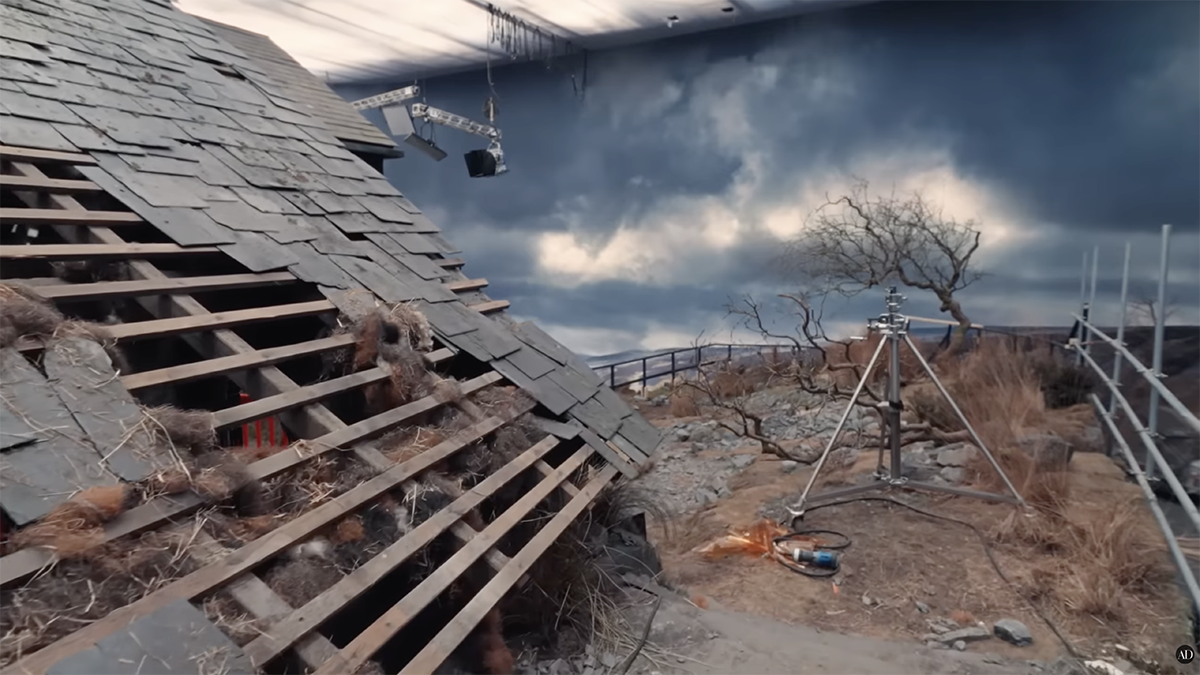
Rosco Day/Night SoftDrop installed inside the Wuthering Heights set. Image sourced from Rosco Spectrum blog.
PDC: When teams are trying to decide whether to use an LED screen, a backdrop or a green screen, what are some of the biggest misconceptions you've encountered?
Greenstreet: It's not necessarily a misconception, a mischaracterization perhaps is that backdrops are old technology and because it's old, it must be bad. But in reality, the way that we make backdrops has kept up with technology; the things you can do with it continue to advance. Like I said, you can add motion, you can create a lot of different changes.
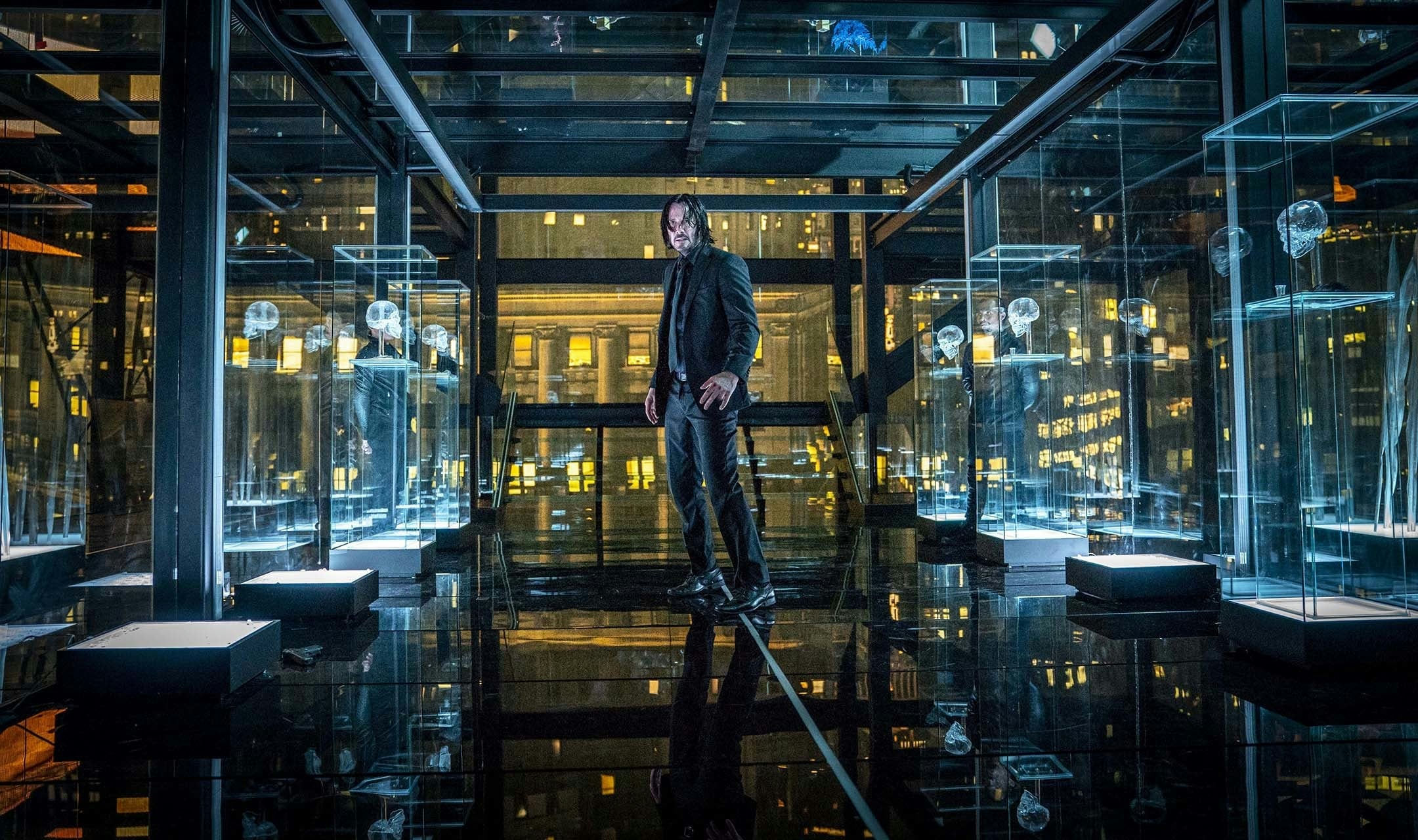
The idea that blue screen is better because it's new is just incorrect. When we did John Wick 3, they had a glass office. And if you only used a blue or green screen, the bounce of green and blue throughout the office would have been terrible. A backdrop made a lot more sense because every reflection is true to what should be outside the window. It becomes an illuminant source.
With our SoftDrops, you shoot it, you print it, you hang it and then you switch the lights on and off at the end. Then you come back the next day, and you just switch it back on again. Whereas something like an LED screen, you have to get your guys in hours ahead just to get everything up and working, make sure there aren't any dead pixels and so on. Although you think it's going to be more efficient, in some ways it's less.
John Wick (Keanu Reeves) enters the labyrinthic manager’s office in John Wick: Chapter 3 – Parabellum. Image sourced from American Cinematographer.
PDC: What is a favorite backdrop that you've worked on?
Greenstreet: Probably the best one for me was on a show called Halston. It was a big office, it was period, it was New York City. There was a lot of stuff going on outside the windows. The art department even created subscale spires for St. Patrick's Cathedral, so there's some parallax in relation to the spires.
Mark Ricker was the production designer, and people were asking him which volume stage he shot that on because the assumption was the only way you could do that would be on a volume stage, when in fact it was just a regular stage with a very large SoftDrop. It looked great. It was just a very satisfying show to have been part of.
PDC: And how about a project that specifically demonstrated the potential of Day/Night technology?
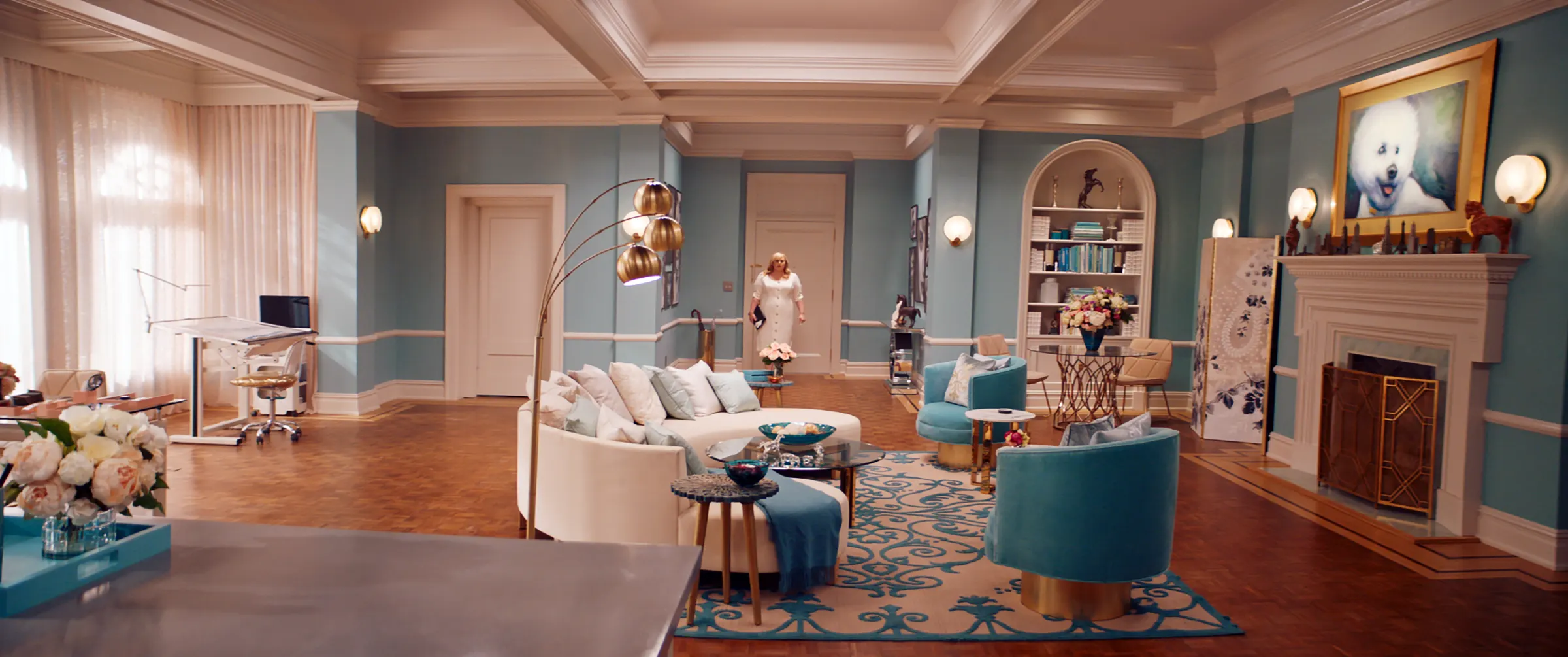
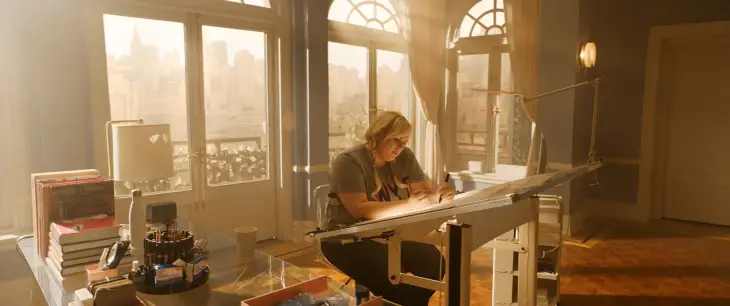
Greenstreet: In Isn't it Romantic? there's a sequence where the actress is sitting at a drafting table and the camera comes around on her. It's supposed to show her working all day, so as the camera comes around, they transition the backdrop and lighting from day to night.
You actually see a live change from full-on morning to full-on night over this 24-hour cycle in a single shot. That's probably the best showcase for Day/Night, because it's like, well, how else would you do this?
Stills of interior set for Isn't it Romantic? with a fantastical Manhattan skyline view created by the Rosco Digital Imaging team. Production design by Sharon Seymour.
PDC: Lastly, what should designers keep in mind when planning for a Day/Night SoftDrop or any backdrop in general?
Greenstreet: Time. Just start early. There's rarely enough time, and it's always some kind of rush. In our production schedule we're dealing with a lot of projects, so to avoid any delays we recommend communicating as early as possible.
And tell us everything. Don't hold back, because it's those little snippets of information like “Oh, by the way, it's 1933" That really makes the difference. Just give us as much information as possible up front.